
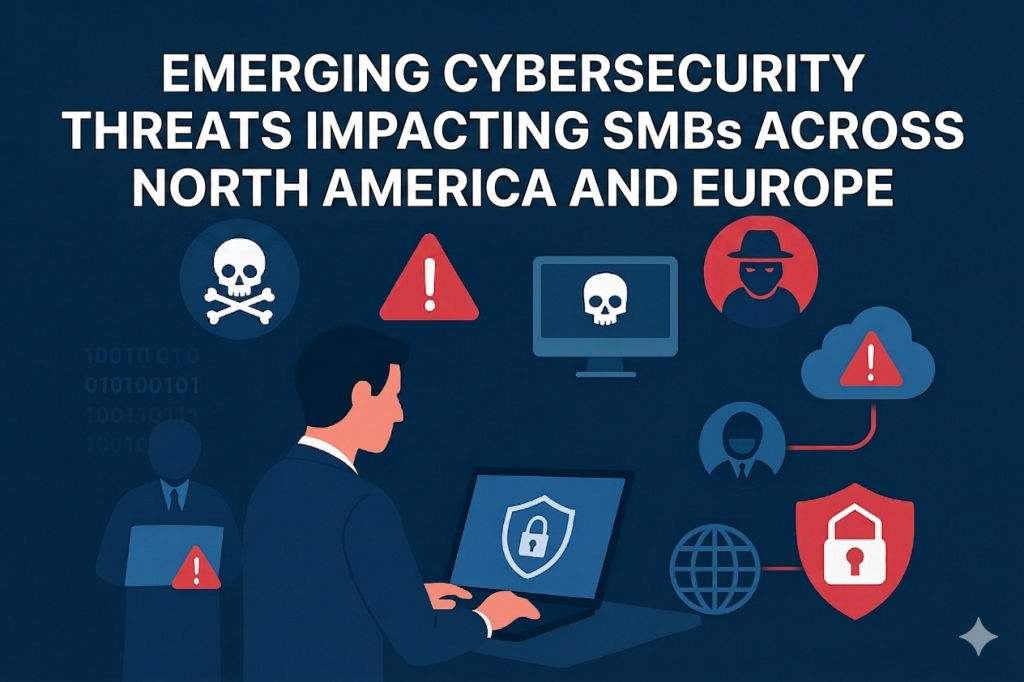
In 2025, small and medium-sized businesses (SMBs) in Canada face an increasingly complex and hostile cyber-landscape. The bad news? Attackers don’t just go after large corporations anymore — SMBs are now major targets. The good news? By understanding the top threats and taking proactive steps, you can position your organisation ahead of the curve.
Why SMBs Are Primed Targets
According to recent data:
- A key report shows that 72% of Canadian SMBs reported being attacked by cyber-criminals in the past year. 21628522.fs1.hubspotusercontent-na1.net+2Newswire+2
- Another study found nearly 1 in 5 SMBs would be forced to close if hit by a successful cyberattack. vikingcloud.com
- SMBs often have limited security budgets, fewer dedicated cyber specialists and less mature governance frameworks — making them attractive low-hanging fruit for threat actors.
Given this backdrop, here are the most urgent threats for Canadian SMBs in 2025 — and how you can prepare for them.
1. AI-Powered Phishing & Social Engineering
Phishing is nothing new, but in 2025, it has evolved. Attackers are leveraging generative AI and machine learning to craft highly convincing impersonations of trusted contacts, institutions, or vendors. Total Assure+2iTWire+2
Example: An email that appears to come from a vendor asking for invoice payment, but is actually orchestrated by a cyber-criminal.
Why SMBs should care:
- Many SMBs still rely heavily on email and lack advanced detection tools.
- Human error remains one of the main vectors of breach.
- Once credentials are stolen, attackers can move laterally, escalate privileges, and gain deeper access.
2. Ransomware and Double/Triple Extortion
Ransomware continues to be a dominant threat, but tactics are changing. In 2025, we’re seeing more double/extortion, where data is stolen and encrypted, with criminals threatening to publish sensitive information if ransom isn’t paid. Acera Insurance+221628522.fs1.hubspotusercontent-na1.net+2
Canadian context:
- Data shows that ransomware and business email compromise (BEC) accounted for a large share of incident investigations in Canada. KPMG Assets
- The shift means even SMBs that don’t store huge volumes of sensitive data are still at risk because the reputational damage or business interruption alone can be unbearable.
Key defence actions:
- Ensure offline, immutable backups.
- Develop and test your incident response (IR) and business continuity plans.
- Maintain visibility of your data, including exfiltration detection.
3. Supply Chain / Third-Party & Vendor Risks
In 2025, attackers increasingly target the “weakest link” in a supply chain, which can be a third-party vendor, service provider, or SaaS platform. corkinc.com+1
Why this matters for SMBs:
- Many SMBs outsource IT, cloud services, or data handling, but may not have full visibility or control over those partners’ security posture.
- A breach at a vendor can cascade into your environment, even if your internal defences were solid.
- Regulatory and reputation risks increase when vendor breaches impact your business or customers.
Recommended actions:
- Perform vendor risk assessments and require minimum cybersecurity standards in contracts.
- Monitor vendor security posture and ensure you have notification rights if a breach occurs.
- Limit the access and permissions third parties have to your core systems (“least privilege”).
4. Weak Credentials, Access Management & Identity Attacks
Credential misuse and identity compromise remain major threat vectors, especially in mixed hybrid/remote work environments. BDO Canada+1
Key risk factors:
- Shared or reused passwords, poor multi-factor authentication (MFA) implementation.
- Legacy systems or unmanaged accounts.
- Attackers are using stolen credentials to pivot into more sensitive systems.
What SMBs should do:
- Enforce strong password policies and enable MFA on all critical accounts.
- Conduct regular audits of user access, privileged accounts, and orphaned credentials.
- Adopt zero-trust or identity-first security models.
🖼️ Image Prompt:
A user typing a password on a laptop, with a shadowy silhouette looming behind, and an icon representing “access granted” turning red.
5. IoT, OT and Legacy Systems Vulnerabilities
Many SMBs operate with legacy infrastructure or have deployed IoT/operational technology (OT) devices without proper segmentation or security controls, creating exploitable entry points. Entre Technology Services+1
Examples and impact:
- Manufacturing SMBs with smart sensors connected to corporate networks.
- Office buildings with smart HVAC or security systems that aren’t updated.
- Legacy servers and unsupported applications are still in use.
Defensive steps:
- Map all devices (IT/OT/IoT) and segment them from core business networks.
- Apply patches and updates consistently, or retire unsupported systems.
- Monitor device behaviour and restrict inbound/outbound connectivity.
6. Cloud Security, Remote Work, and the Changing Workplace Landscape
As SMBs embrace cloud services and hybrid/remote work models, new exposures arise. iTWire+1
Key vulnerabilities:
- Employees accessing cloud apps over unsecured home networks or personal devices.
- Misconfigured cloud storage (publicly exposed buckets) or weak cloud-identity controls.
- Shadow IT: staff using SaaS tools without IT/security oversight.
What to focus on:
- Secure remote access (VPN, zero-trust network access).
- Enforce consistent cloud-governance: identity, roles, permissions, logging.
- Provide training for remote workers on safe practices and secure devices.
7. Emerging Technologies: AI, Autonomous Malware & Quantum Threats
The threat landscape in 2025 is increasingly shaped by advanced technologies. Acera Insurance+1
- AI-driven attacks: Malware that adapts, phishing messages crafted by AI, deepfakes for impersonation.
- Quantum threat horizon: While still emerging, the “harvest now, decrypt later” risk vector means adversaries may steal data now and decrypt it when quantum computing matures.
These may seem futuristic, but smaller businesses must prepare now to avoid being caught flat-footed.
Putting It All Together: What SMBs Can Do Right Now
Here’s a quick action checklist for Canadian SMBs to strengthen their cybersecurity posture in 2025:
- Conduct a cybersecurity risk assessment tailored to your business goals and threat landscape.
- Develop or update your cybersecurity governance framework (e.g., align with ISO 27001, NIST Cybersecurity Framework).
- Secure identities: enforce MFA, review access rights, and adopt least-privilege.
- Train your people: run phishing simulations, awareness campaigns, and remote-work safe-practice training.
- Secure your supply chain: assess vendor risks, monitor third-party access.
- Invest in backups and continuity: prepare for ransomware or system downtime.
- Monitor, measure, and adapt: track KPIs like incident response time, training completion, and audit outcomes.
- Stay ahead of emerging tech threats by keeping informed and planning for what’s next.
Conclusion: Don’t Wait — Defend Now
For SMBs in Canada, cybersecurity is no longer optional; it’s strategic. The threats in 2025 are more aggressive, more automated and more targeted than ever. But by proactively aligning your strategy with your business goals and taking concrete steps, you can turn risk into resilience.
At TransAtlantic Oak Security, we specialise in helping Canadian SMBs build governance-led, business-aligned cybersecurity programs that don’t just defend, but also support growth, trust, and compliance.
[Book Your Free Consultation →]
